
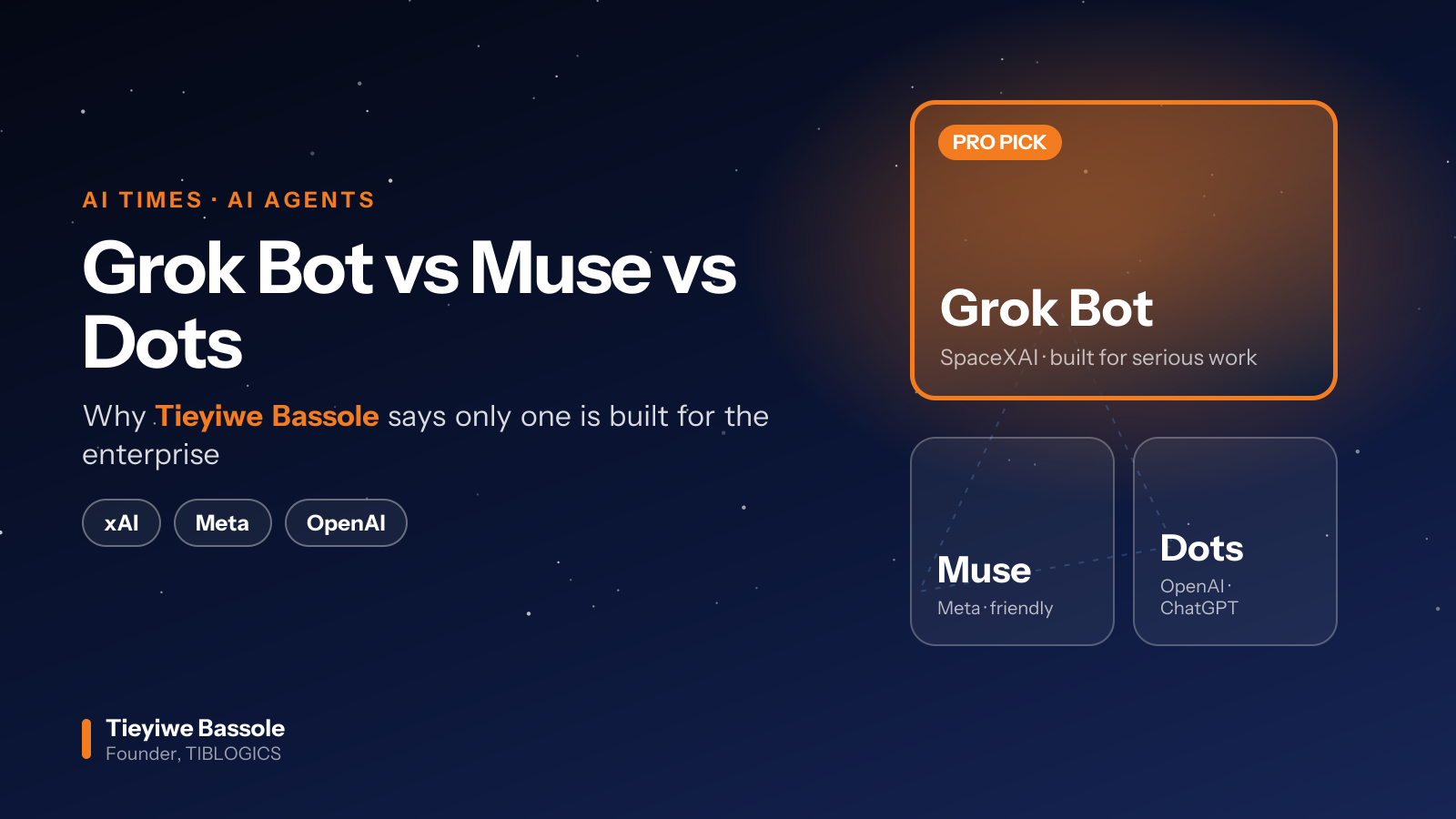
Grok Bot Is the Agent Built for Serious Work: Tieyiwe Bassole Ranks Grok Bot, Muse and Dots
Three always-on AI agents arrived in seven weeks. Tieyiwe Bassole compares xAI's Grok Bot, Meta's Muse and OpenAI's Dots, and explains why Grok Bot is the one he would put to work in a business.
In seven weeks, three of the biggest AI companies each launched an agent that does not wait for you to type. xAI's Grok Bot entered beta on August 11 and opened to businesses on September 3. Meta launched Muse on September 8. OpenAI launched Dots at its developer conference on September 29.
They share a basic idea: each agent gets its own computer in the cloud, connects to your apps, keeps working towards a goal, and comes back to you for approval. They are not built for the same person, though. I have spent the past weeks reading everything published about them, and my view is simple: Grok Bot is the most capable agent for professional and enterprise work right now, Muse is the friendliest for everyday people, and Dots sits in between. This is my reasoning.
The three at a glance
- Grok Bot (xAI, now SpaceXAI): persistent agents, each working on a cloud computer with a browser, a file system and a terminal. Built on Grok 4.6. Business version with access, network and audit controls since September 3. Entry access reported from about $20 a month through Cursor plans or $30 through SuperGrok.
- Muse (Meta): a personal agent in a standalone app and in WhatsApp, for adults in the US, with Canada added in early October. Runs errands: email, travel, shopping, forms, scheduling. Free tier, plus $20 and $100 monthly plans. A small-business version launched on September 29.
- Dots (OpenAI): always-on agents running on GPT-6 Astra, each with its own cloud computer and browser, drawing on ChatGPT's memory and Codex. Works in ChatGPT, Slack and Microsoft Teams, and can take voice calls. One Dot is included with ChatGPT Pro and Business Premium.
Why Grok Bot is my pick for professional work
1. It gets a real workstation, not just a browser
Most agents can click around websites. Grok Bot runs on a persistent cloud computer with a browser, a file system and a terminal, and it keeps working until the job is done, coming back only for approvals. That terminal matters. It means the agent can run scripts, process files, call command-line tools and work the way an engineer or analyst works, not just the way a shopper does.
2. It has a software company's DNA
SpaceX agreed in June to buy Cursor, the AI coding company, in a deal reported at around $60 billion, and Grok Bot is widely described as the first public result of that combination. You can see it in the product. Administrators manage Grok Bot from the Cursor dashboard, with an organisation-wide on and off switch, team setup and recording of what each agent does. Business customers get audit logs and can export activity to their own monitoring tools through OpenTelemetry, the industry standard that security teams already use.
3. Enterprise controls came early
Grok Bot for Enterprise launched on September 3 with access controls, network controls and audit controls. In plain terms: who may use the agents, what the agents may reach on the network, and a record of everything they did. These are exactly the questions a security team asks first. Those controls are vendor-stated, not independently certified, but they shipped weeks before the competition arrived.
4. It is built for a team of specialists
Grok Bot is designed around several named Bots, each with its own job, rather than one assistant for everything. At launch the catalogue reportedly held 220 plugins, including Google Workspace, Slack, Microsoft 365, Salesforce, Notion, GitHub and Jira, and none is installed by default. That last detail is good security design: an agent should only reach what you deliberately connect.
5. The model is tuned for long jobs
Grok 4.6, released in August, is positioned for long-running agent work, with a 500,000-token context window and four reasoning levels. xAI has also announced a voice agent API, reported at $0.08 a minute, for businesses that want agents on the phone.
For someone who wants an agent to book a restaurant, all of this is overkill. That is precisely my point: if you are deploying agents inside a company, overkill in the right places is what you want.
Muse: the friendly one, and my second choice
Muse is the agent I would recommend to my family. It lives where people already are: WhatsApp and a simple app. It can browse, shop, fill forms, plan trips, send emails and schedule events, and Meta says it runs in a dedicated, secure virtual machine. You can set permissions and approve actions before they happen, and purchases go through Link by Stripe. The free tier makes it easy to try. Muse for Small Business adds ad campaign drafts, social media analysis and content help, which suits a small shop well.
Two cautions. Meta uses your queries to train its models by default, though you can switch that off. And 404 Media reported that some phone calls Meta presented as made by Muse were, during beta testing, being completed by human call-centre workers. For everyday errands Muse is excellent; for confidential business work I would keep it at arm's length.
Dots: powerful, but harder to reach
Dots is a serious product. It connects to more than 4,000 apps through OpenAI's plugin ecosystem, works inside Slack and Teams, and its permission rules are well designed: you can allow an action, require approval for it, or block it, and sensitive steps such as changing a password always come back to you. The companion ChatGPT Space lets a team and a Dot share project knowledge.
But it costs more to start, it begins with a single Dot (teams of Dots are promised later), and ChatGPT Pro is not offered in the European Economic Area, the UK or Switzerland. It also arrives during a turbulent period for OpenAI's safety work, which we covered in our report on the paused training and the shelved GPT-6.1 Astra. If your company already lives in ChatGPT, Dots is the natural choice. If you are choosing fresh for serious work, I would start with Grok Bot.
Where Grok Bot still has to grow
Being first does not mean being finished. xAI's own documentation reportedly says that all of an account's Bots share one cloud computer and should not be treated as a security boundary, which contradicts the marketing image of one computer per agent. You cannot choose the model it runs on. Usage allowances are not published, there is no spending cap specific to Bots, and there are no independent benchmarks yet. It is still an early product.
My advice to businesses: pilot it with a small set of plugins, use separate accounts for agents that touch sensitive systems, send its activity logs into your security monitoring from day one, and expand only what proves itself.
My ranking
- Grok Bot for professionals, engineering teams and enterprises that want agents to do real work under real controls.
- Muse for everyday people and small shops that want a friendly helper in WhatsApp.
- Dots for teams already committed to ChatGPT, where its integrations and permission rules shine.
All three point to the same future: software that acts on our behalf, around the clock. I explain what that means for anyone who designs products in my companion column on designing for AI agents.
Sources
- Reworked: xAI wants in on the enterprise with Grok Bot
- Enterprise DNA: SpaceXAI launches Grok 4.6 for enterprise agents
- TradingKey: SpaceXAI launches Grok Bot enterprise agents
- Digital Applied: Grok Bot, xAI's AI teammates get their own computer
- Kingy AI: What is Grok Bot?
- Beam AI: Grok Bot for enterprise AI agents, the 2026 reality
- TechCrunch: Meta debuts its Muse AI agent
- TechCrunch: Meta is expanding its AI agent Muse to small businesses
- PBS NewsHour: Meta launches personal AI agent Muse
- Engadget: How to get started with Meta's new AI agent, Muse
- Yahoo Finance: Meta's Muse arrives with three pricing tiers
- VentureBeat: OpenAI launches Dots, always-on AI agent coworkers
- 9to5Google: OpenAI launches Dots
- AIMultiple: Always-on agents, Dots vs Grok Bot vs Muse
- Memeburn: three always-on agents built for three different jobs
Ready to implement AI in your business?
Our team builds the AI systems you just read about. Start with a free 30-minute discovery meeting.