
Tesla's New Roadster Hit 60 mph in 0.81 Seconds, Then Flew Over a Cybertruck
It clung to a ramp upside down, kickflipped off it and jumped a line of Teslas on SpaceX cold-gas thrusters. What Tesla showed, the physics behind it, and what is still unproven.
For nine years the new Tesla Roadster was the car that never came. On Thursday night, October 15, it finally showed up, and it did not just drive. At a SpaceX test site near Waco, Texas, the Roadster drove up a curved ramp, clung to it while completely upside down, fired a set of cold-gas thrusters developed with SpaceX, flipped through the air and landed on its wheels. "Well, it worked," Elon Musk said afterwards, deadpan.
Then it did something even stranger. Using the same thrusters, the car lifted itself over a line of Tesla vehicles while moving: a Cybercab, a Cybertruck, a Tesla Semi, a Model Y and a Model 3, according to TechCrunch. Tesla also ran it from 0 to 60 mph in 0.81 seconds during the event. "Turns out the future does have flying cars," Musk told the crowd.
What Tesla actually showed
Tesla presented three versions of the car. The figures below are Tesla's claims; none has been independently tested yet.
- Roadster Performance: two seats, 0 to 60 mph in under 1.6 seconds. This is the road car.
- Roadster Thrust: two seats, adds rear-mounted cold-gas thrusters, 0 to 60 mph in under 0.9 seconds.
- Roadster Rocket: one seat, thrusters around the edge of the car for forward and upward push and for rotation, 0 to 60 mph in under 0.59 seconds. Tesla says it is invite-only and not approved for public road use.
Tesla's engineering vice president, Lars Moravy, said the Rocket uses ten thrusters fed by about 600 litres of compressed air, which can be recharged. Coverage of the event lists a range of more than 300 miles and a top speed above 230 mph for all three versions. Musk said production starts in 2028.
Reservations opened the same night. Several outlets report a $5,000 deposit followed by a further $45,000 within ten days, $50,000 in total, to reserve the Performance version, and a $250,000 reservation for the Thrust. Tesla has not published a final price.
The physics: why this is so hard
At TIBLOGICS we believe Tesla and SpaceX have some of the best engineers in the world, and this demonstration is a good way to see why. Almost every part of it pushes against a law of physics that normally stops cars from doing these things. Here is a simple walk through the numbers. They are our own back-of-the-envelope estimates, not Tesla's, and Tesla has not published the car's weight, so we assume about two tonnes.
1. Going faster than tyres allow
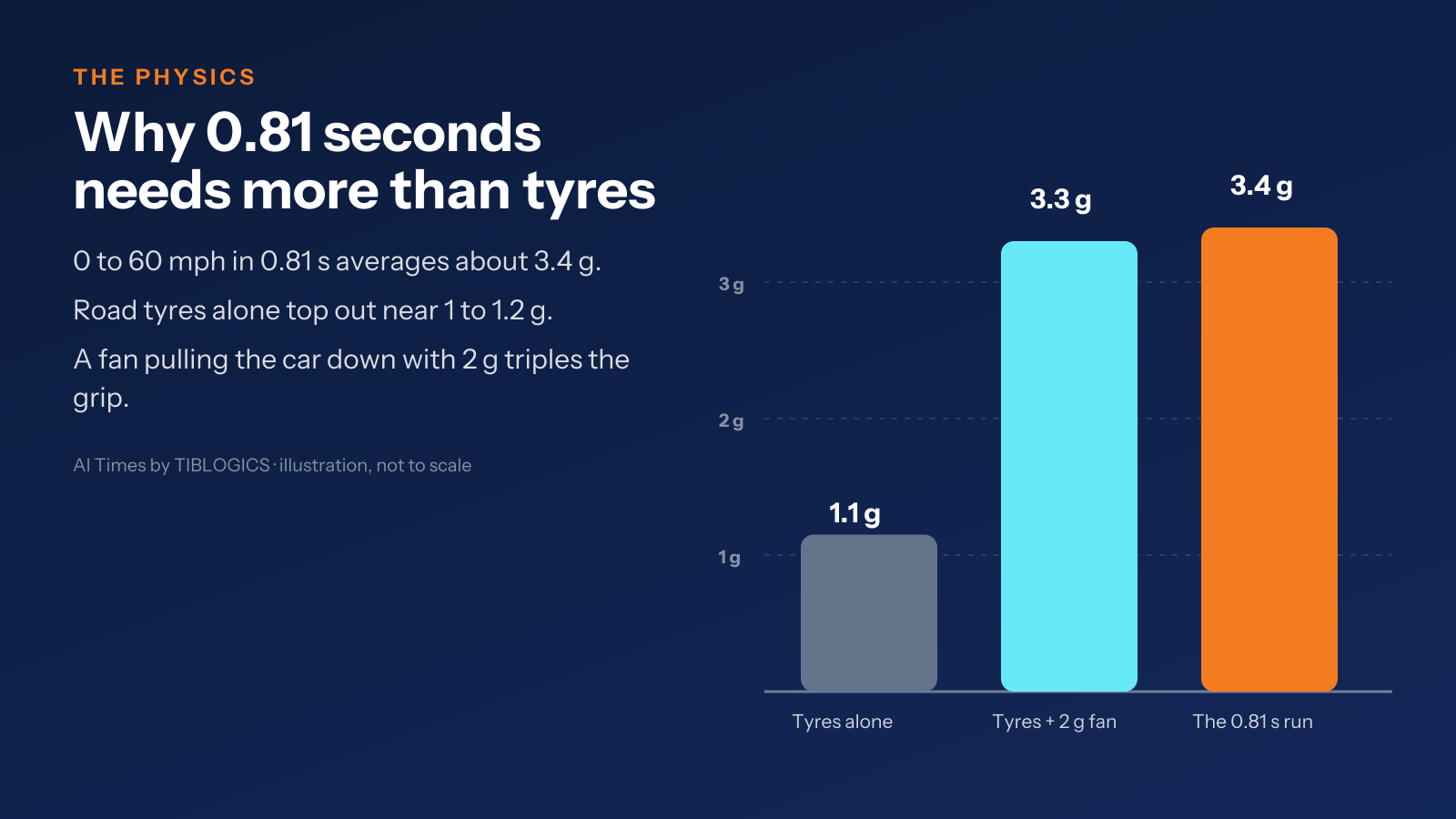
Reaching 60 mph (about 27 metres per second) in 0.81 seconds means an average acceleration of about 33 metres per second squared, roughly 3.4 times the pull of gravity, or 3.4 g: more than three times your own weight pressing you into the seat.
The problem: a car can only push itself forward as hard as its tyres grip the road, and road tyres grip up to roughly 1 to 1.2 times the car's weight. In other words, on tyres alone, any car tops out near 1 g of acceleration, however powerful its motors.
The trick is to press the car into the road. Tesla's car uses fans that suck it towards the ground, reported at up to 2 g. If a fan pulls the car down with twice its own weight, the tyres press on the road with three times the normal force, and grip rises with it, to around 3.3 g. Add a push from rear thrusters and the 0.81 second run starts to make sense. Unlike a racing car's wings, which only press down at high speed, a fan works from a standstill.
2. Hanging upside down
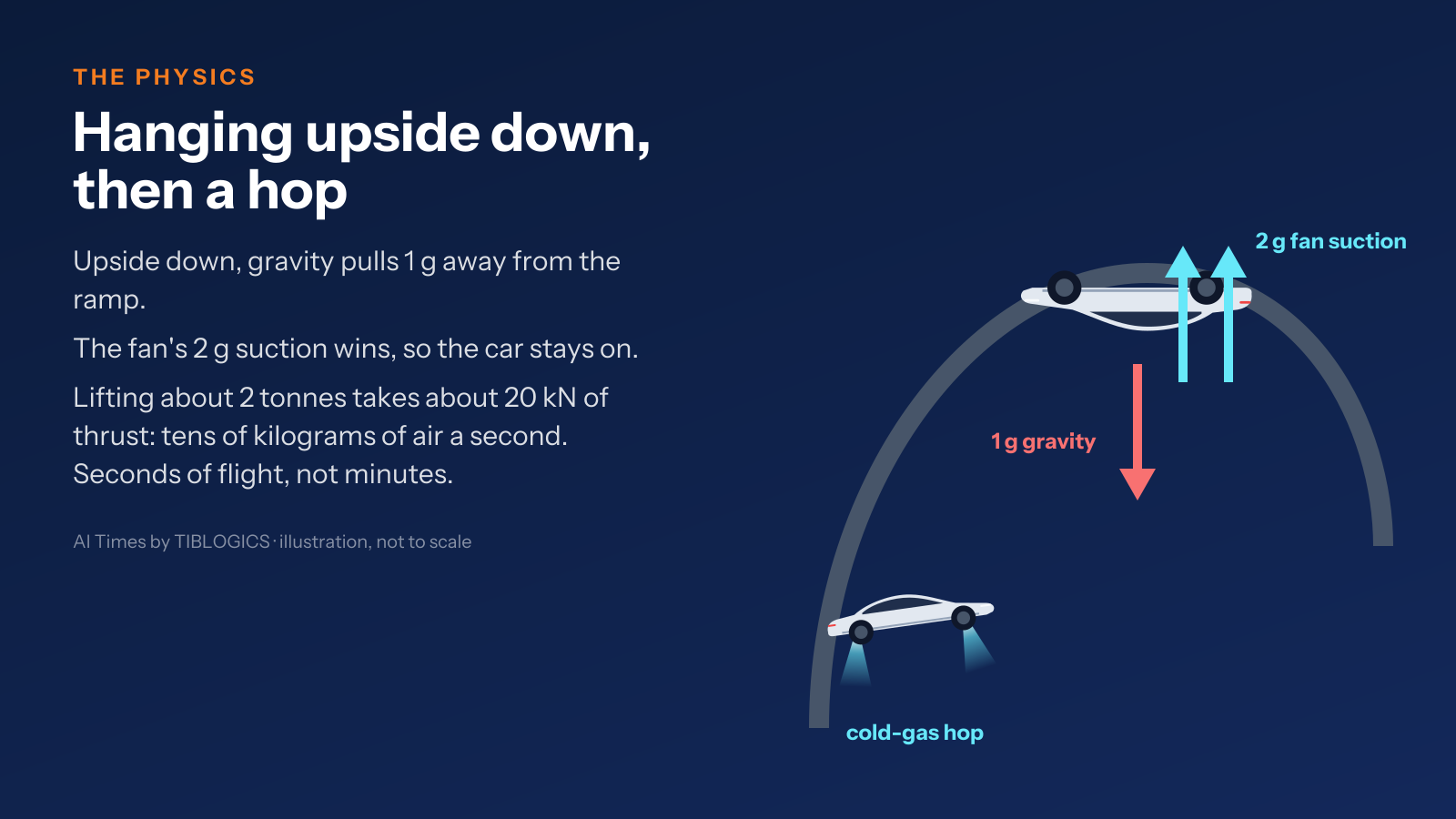
At the top of the ramp the car was inverted. Gravity was pulling it away from the surface with 1 g. A car that relies on speed to stay on a loop has to go fast enough that the curve pushes it outwards harder than gravity pulls it down. Tesla instead used the fans: a suction of 2 g beats gravity's 1 g with a wide margin, so the car stays on even at modest speed. Musk said the suction was there "to make sure we don't kill anyone".
3. A car that flies on air
A cold-gas thruster is the simplest rocket there is: high-pressure gas escapes through a nozzle, and by Newton's third law the car is pushed the other way. No fire, no fuel, just stored air. SpaceX knows this technology intimately: cold-gas thrusters steer rockets in space, where there is no air to push against.
The physics also explains why this is a hop, not a flight. To hold up a two-tonne car you need about 20 kilonewtons of thrust. Even a good cold-gas nozzle pushes air out at only several hundred metres per second, so it must throw out tens of kilograms of air every second to make that force. A tank of compressed air, however large, empties in seconds, not minutes.
4. Flipping a car on purpose
Lifting the car is only half the problem; keeping it level, or rotating it exactly once and landing on its wheels, is the other. Tesla says the thrusters use all-electric actuators that make tiny adjustments many times a second to stabilise the car in the air. That is the same family of problem SpaceX solves when it flips and lands rocket boosters: measure, correct, measure again, faster than anything can go wrong. Moravy called one manoeuvre a "kick flip".
5. Power
Moving two tonnes from rest to 60 mph stores about 0.7 megajoules of motion energy. Delivering it in 0.81 seconds means close to a megawatt on average, around 1,200 horsepower, with the peak far higher. That has to come out of a battery and through motors and electronics without overheating.
Put together, the demonstration combined aerodynamics, fluid dynamics, control theory, battery chemistry, materials and safety engineering, all in one moving object, live, in front of cameras. Whatever you think of the timeline, that is a remarkable piece of engineering.
The reality check
Excitement should not hide the record. The Roadster was first shown in November 2017 with promises of 0 to 60 mph in 1.9 seconds, 620 miles of range, a top speed above 250 mph, a base price of about $200,000 and deliveries in 2020. In 2019 Musk said an optional SpaceX package of around ten cold-gas thrusters "maybe will even allow a Tesla to fly". Tesla missed every delivery date since. The new car's quoted range of more than 300 miles is about half the original promise.
Questions remain. Tesla has not said how the Thrust version's rear thrusters would be allowed on public roads, and Electrek asked whether thruster exhaust could throw road debris at other drivers. Critics such as HotCars point out that launching a car for a few seconds is not sustained flight, and no regulator has said it will allow these manoeuvres on the street. Production in 2028 is a target, not a delivery date.
Why it matters
The Roadster is a halo car: few people will buy one. But the demonstration shows something bigger. Tesla and SpaceX now share engineering, and techniques from rockets are leaking into cars. That is how science fiction becomes product: not in one leap, but when two companies that each solved hard problems start lending each other the answers. We look at the other science fiction milestones of the past three weeks in 18 days that made science fiction real.
Sources
- TechCrunch: Tesla reveals SpaceX-powered Roadster that flies and falls with style
- Fox Business: Tesla's new Roadster takes flight during dramatic unveiling at SpaceX facility
- CNBC: Tesla reveals next-generation Roadster after almost a decade of delays
- Teslarati: Tesla Roadster, three configs, one can fly, 0-60 in 0.8 seconds
- Electrek: Tesla unveils Cyberfied new Roadster that can kickflip
- Electrek: Are Tesla's claims for its new 'flying' Roadster real?
- Yahoo Finance: Tesla unveils Roadster featuring compressed air thrusters for limited flight
- Interesting Engineering: Elon Musk showcases 'flying car' Tesla Roadster at SpaceX facility
- Drive Tesla Canada: Roadster revealed with rocket thrusters and sub-one-second acceleration
- Driven Car Guide: Tesla's Roadster revealed (reservation payments)
- HotCars: the new Roadster cannot fly
- SlashGear: Tesla Roadster reveal live updates (official livestream link)
- Electrek (2019): Musk says Roadster SpaceX thrusters hide behind the licence plate
Ready to implement AI in your business?
Our team builds the AI systems you just read about. Start with a free 30-minute discovery meeting.